Δευτέρα 30 Ιουλίου 2012

Africa: 'A Servant of Africans, Not South Africa' - Dlamini-Zuma's Ground Rules


ANALYSIS
Photo: http://www.sanews.gov.za/
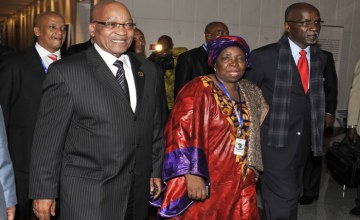
South African President Jacob Zuma walks with Home Affairs Minister Nkosazana Dlamini-Zuma (file photo).
Pretoria — Speaking for the first time since her election to the chair of the African Union Commission, Nkosazana Dlamini-Zuma told a gathering of the ANC Women's League that she would not be a lackey of South Africa's own interests in her new position.
The ANC Women's League convened at the Pretoria City Hall on Sunday to listen to the newly elected African Union Commission Chairperson, Nkosazana Dlamini-Zuma, clarify the workings of the African Union and her new role within it. It turned out to be quite a celebration.
The floorboards at the City Hall squealed noisily under the strain of the dancing comrades, and the deference paid to Dlamini-Zuma in song, dance and spoken word was indicative of just how much Dlamini-Zuma's election has meant to the ANC-led government - especially given that there has not been much else to celebrate lately.
Sunday's Women's League event was, however, also a timely reminder of Dlamini-Zuma's own popularity within the ANC. Even if her deployment to the AU was not an astute move by President Zuma to cut out any more competition in Manguang, having Dlamini-Zuma shipped off to Addis Ababa certainly does not harm Zuma's campaign for a second term. She is not just a popular figure in the ANC, she is also a capable figure. Unlike the venerable president, Dlamini-Zuma has a proven track record of actually getting things done. It is, then, rather convenient for Zuma to put a few thousand miles between himself and his old missus.
But apart from how Dlamini-Zuma's AU election success may affect the skulduggery of the ANC leadership battle, it is clear that her new position is something with which the ANC is still grappling. Deputy Minister of Economic Development, Hlengiwe Mkhize, said the Women's League had decided to host the event in order to hear from Dlamini-Zuma herself what her election to the African Union signified. "We wanted to hear from her instead of reading about it in the media," Mkhize said.
Nonetheless, it was Minister of International Relations and Cooperation, Maite Nkoana-Mashabane, who looked like the cat that got the cream. And it's not difficult to work out why she is so pleased. Dlamini-Zuma's ascension to the chair of the African Union Commission feeds into South Africa's ambitions for permanent representation at the United Nations.
Dlamini-Zuma, however, is not set to be Mashabane's "number two" at the African Union - in fact, she's not expected to be number two anywhere, if her reputation as a powerful personality is anything to go by. As Fatima Nahara, an NEC member of the Women's League, said in her introduction of Dlamini-Zuma, "With Nkosazana, you know no means no."
Dlamini-Zuma herself later cautioned the Women's League delegates, "When I go [and] work, I'll be working as a servant of Africans, and not South Africa. As South Africa, we have to locate ourselves in that pan-Africanism, and not just narrow self-interest."
Dlamini-Zuma made clear that she would be guided by a vision to wrest the thrust of African politics from the interests of the West, and ensure instead that Africans themselves determined their own reactions to the continent's challenges. She spent much of her hour-long speech reflecting on how exactly Africa became the basket case of the world.
"We have a proud history, a proud heritage, but what went wrong?" she asked.
It became clear, following this rhetorical question, that she believed a greater degree of agency would be the key to developing the African continent in the long term. "What went wrong is when people from the west began taking African people as slaves," she said. "It started with slavery; the healthiest and fittest were taken away for the benefit of the imperialist countries. Those who did that thought we were sub-human And following [that] was colonialism, [where] Europeans carve[d] up Africa the way we see it today and distributed it amongst themselves as if we were just flora and fauna.
"Their aim was to exploit the continent and its people for their own enrichment."
The underlying theory, then, is that Dlamini-Zuma will fight to counteract this history of ownership and the resultant poverty and instability. On a practical level, however, there was little indication of how she would drive this through her leadership of the AU Commission.
In short, beyond the rousing rhetoric, she failed to comment on any trenchant matters of African politics. She spoke passionately of the position of women in various pre-colonial African societies, noting that the Malian city of Timbuktu was named after a woman, but failed to note that the very same city had in the last month borne the onslaught of marauding rebel forces battling for the newly declared state of Azzawad in northern Mali.
Yet it would have been a pertinent starting point. Dlamini-Zuma's steering of the inevitable intervention in northern Mali will be one of her first tests in her new position. Although the West African body regional body Ecowas has been at the forefront of the crisis in Mali, negotiating with the rebels and applying to the United Nations Security Council for help, France has also displayed its readiness to lend a hand in beating back the rebels. Balancing the apparent generosity of France against the drive to solve African problems with home-grown solutions will severely test Dlamini-Zuma's philosophy of asserting African agency against the hegemony of the former colonial powers and the US.
But South Africa has installed her in this position to ensure that the direction of the African Union Commission is handled ably enough to assist the stances it takes in the United Nations Security Council.
Conflict in Libya and Ivory Coast have left bitter after-tastes on South African palates, and much of the energy expended by Dirco recently has sought to avert a repeat of Libya and the Ivory Coast. At the helm of the Security Council last January, South Africa sponsored a resolution that ensured the Security Council worked more closely with regional bodies - particularly the African Union. All this then, is aimed at ensuring the West is no longer perceived to influence the prickly points of African politics.
She noted, however, that the African Union couldn't subsist in itself.
"We are not an island; we are a continent. We have to deal with other countries," she said. "The AU, besides working with member states, is also working with the world.
"We [have branches like] the AU-China forum, where we see how we can work with China for mutual benefit. There is also an AU-India forum."
These forums will form a critical test of her ability to maintain greater autonomy on the African continent. In her address, she acknowledged that the relationship between the African Union, China and India - contemporary colonial powers, as some tout them - was skewed and, reflecting on funding of the African Union sourced from these countries, she said, "This is fine for now, but I hope in time we will have an equal relationship."
Dlamini-Zuma is certainly aware of one of the greatest obstacles to exercising her philosophy in her new role. She will battle to win the loyalty of dissidents to South Africa's relentless drive for the leadership of the AU Commission, but appears confident that she will succeed.
"Right through the history of the Union we have emphasised unity, and now it's also important," she said. "With political will, we can do it."

iMaverick is South Africa's first daily tablet newspaper and includes coverage from the Daily Maverick and Free African Media. To subscribe, go to: www.imaverick.co.za.

South Africa the unhealthiest BRICS member


South Africans get a worse deal on health than the residents of any other Brics country, Health Minister Aaron Motsoaledi said on Monday.

On aggregate, South Africa fared worse than Brazil, Russia, India and China on standard health indicators, he said in Winterton in KwaZulu-Natal.
The average South African was expected to live until 54, while the Chinese could live to the age of 74, Brazilians to 73, Russians 68, and Indians 65.
Infant mortality in South Africa stood at 43 deaths per 1 000 live births, and 62 children out of every 1 000 would not make it to their fifth birthday.
Only India had worse figures, at 50 and 66 deaths per 1 000 respectively.
By comparison, Brazil and China had an infant mortality rate of 17 deaths per 1 000 live births, and Russia of 11 deaths per 1 000.
Only 12 out every 1 000 Russians would not live to see their fifth birthday.
Maternal mortality ratios and adult mortality rates made for bleak reading. According to Motsoaledi's presentation, on average 410 South African mothers out of 100 000 died during pregnancy or childbirth.
In India that figure was 230, in Brazil 58, in Russia 39, and 38 in China.
According to Motsoaledi's figures, 521 out of every 1 000 South African men aged 15 to 59 die before turning 60.
In China, that figure was 142, Brazil 205 and India 250. Russia came closest to South Africa at 391.
Motsoaledi said the number of people who died annually in South Africa almost doubled between 1997 and 2006, going from 317 131 to 612 462.
Many of South Africa's dire mortality statistics could be attributed to communicable diseases, especially HIV and tuberculosis.
Compared to its Brics partners, South Africa had the worst figures.
Only Brazil spent more than South Africa's 8.5% of gross domestic product on health.
South Africa fared fairly well in curbing smoking.
Russia, China, and India all had greater percentages of tobacco smoking in men older than 15 than South Africa's 29.5%.
In Russia, 70.1% of men over the age of 15 were smokers.
Brazil had the best figures, with only 19.4% of men smoking.
Most of the health indicator figures quoted by Motsoaledi were the most recent available and were for 2010.

«Fynbos»: Ένα ελληνικής καταγωγής μυστήριο ξετυλίγεται στη Νότιο Αφρική


Από τον Λουκά Κατσίκα

Την παγκόσμια πρεμιέρα του σημείωσε εχτές η πρώτη μεγάλου μήκους σκηνοθετική απόπειρα του Χάρη Πατραμάνη στο 33ο Διεθνές Φεστιβάλ Κινηματογράφου του Ντουρμπάν, το οποίο αποτελεί το σημαντικότερο κινηματογραφικό γεγονός της Νότιας Αφρικής. Και οι κριτικές που εισέπραξε η ταινία μιλούν για ένα γοητευτικό αίνιγμα.
Παρουσία των συντελεστών του πραγματοποίησε την παγκόσμια πρεμιέρα του προχτές, στο 33ο Διεθνές Φεστιβάλ Κινηματογράφου του Ντουρμπάν, η ταινία «Fynbos», διεκδικώντας βραβεία σε όλες τις κατηγορίες της σπουδαιότερης κινηματογραφικής διοργάνωσης της Νοτίου Αφρικής. Σκηνοθετημένη από τον Χάρη Πατραμάνη, σε παραγωγή της συζύγου του, Ελένης Ασβεστά, η ταινία (που πήρε το όνομά της από μια εύφορη γωνιά του χάρτη, στην περιοχή του Δυτικού Ακρωτηριού) φέρει την Νοτιο-Αφρικανική υπηκοότητα, αποτελεί το μεγάλο μήκους ντεμπούτο ενός δημιουργού με σημαντική θητεία στον τομέα της διαφήμισης και προξένησε αίσθηση στην πρώτη προβολή της.
Αφαιρετική και απολύτως μινιμαλιστική, τόσο θεματικά όσο και φορμαλιστικά, η ταινία αφορά την περίπτωση ενός ζευγαριού το οποίο καταφθάνει σε μια απόμερη και ειδυλλιακή περιοχή του Δυτικού Ακρωτηριού με σκοπό να εξασφαλίσει εκεί μια πολύ σημαντική επαγγελματική συμφωνία, στην ουσία όμως αποτελεί την ιστορία μιας γυναίκας η οποία εξαφανίζεται μυστηριωδώς.
Μόνο που, όπως προδίδουν τα πρώτα κείμενα που γράφτηκαν την επόμενη της προβολής, το φιλμ δεν αποτελεί ένα αστυνομικό μυστήριο αλλά περισσότερο ένα υπαρξιακό δράμα, το οποίο εκτυλίσσεται σε εξωτικό φόντο. Οι κριτικές που δημοσιεύτηκαν μιλούν, πάντως, για μια φιλμική εμπειρία μεγάλης οπτικής ομορφιάς η οποία τολμά να φανεί πρωτότυπη και διαφορετική, πειραματίζεται με διάφορα κινηματογραφικά είδη, αρνείται να προσφέρει εύκολες απαντήσεις και σαφείς κατευθυντήριες οδηγίες στο κοινό του και «αγγίζει μια ποιότητα και ένα υψηλό επίπεδο τα οποία δεν συναντιούνται συχνά στο εγχώριο σινεμά». Να ευχηθούμε στον Χάρη Πατραμάνη και στο φιλόδοξο εγχείρημά του καλή επιτυχία!

Η Νότιος Αφρική για πρώτη φορά εξάγει περισσότερο κρασί χύμα απ´ ότι σε φιάλες

Κατά το πρώτο εξάμηνο του 2012, οι πωλήσεις κρασιών της Νότιας Αφρικής έχουν αυξηθεί συνολικά κατά 9% κατά τους πρώτους έξι μήνες του 2011. Οι αγορές που επιτρέπουν στα κρασιά της Νότιας Αφρικής να αναβιώσουν την ανάπτυξη είναι οιευρωπαϊκές. Σύμφωνα με όσα αναφέρει σχετικό δημοσίευμα της ΚΕΟΣΟΕ: «Η ευρωπαϊκή κατανάλωση, ευνοεί σαφώς τα χύμα κρασιά (31%) σε σχέση με τα εμφιαλωμένα κρασιά (-9%). Σύμφωνα με στατιστικά στοιχεία, αυτή είναι η πρώτη φορά που το μερίδιο των κρασιών της Νότιας Αφρικής που εξάγονται χύμα, υπερβαίνει την αξία των εμφιαλωμένων κρασιών.

Η πρόσφατη υποτίμηση του νομίσματος της Νότιας Αφρικής (Ραντ 1 = € 0,099) και υψηλότερη από την αναμενόμενη εσοδεία (1,3 εκατομμύρια τόνοι σταφύλια, + 3,5% από το 2011) εξηγεί την επιστροφή στην αύξηση εξαγωγών των κρασιών της Νότιας Αφρικής.
 Το 2011, η Νότια Αφρική εξήγαγε 3,71 εκατομμύρια εκατόλιτρα (-5% από το 2010). Ο Διεθνής Οργανισμός Αμπέλου και Οίνου, εκτιμά ότι το 50% του όγκου των εξαγωγών το 2011 ήταν σε χύμα μορφή, έναντι 40% το 2010».

Τρίτη 10 Ιουλίου 2012

Λιβύη: Προηγείται στις εκλογές η φιλελεύθερη συμμαχία


Η φιλελεύθερη Συμμαχία των Εθνικών Δυνάμεων προηγείται, στις πρώτες βουλευτικές εκλογές που διεξήχθησαν στη Λιβύη μετά την ανατροπή του Μουάμαρ Καντάφι, όπως έγινε γνωστό σήμερα από την εφορευτική επιτροπή.
Το κόμμα του Μαχμούντ Τζιμπρίλ, ο οποίος ήταν πέρσι πρωθυπουργός της μεταβατικής κυβέρνησης, έχει πάρει το προβάδισμα, μετέδωσε το τηλεοπτικό κανάλι Αλ Τζαζίρα, επικαλούμενο τα πρώτα επίσημα αποτελέσματα. Σύμφωνα με την πηγή αυτή, σε ορισμένες συνοικίες της Τρίπολης ο συνασπισμός του Τζιμπρίλ έχει αποσπάσει έως και το 90% των ψήφων.
Το Κόμμα Δικαιοσύνης και Οικοδόμησης των Αδελφών Μουσουλμάνων βρίσκεται στη δεύτερη θέση ενώ τα υπόλοιπα κόμματα λαμβάνουν χαμηλά ποσοστά.
Περίπου 1,6 εκατομμύρια Λίβυοι -από τους 2,8 εκατομμύρια εγγεγραμμένους ψηφοφόρους- προσήλθαν στις κάλπες το Σάββατο για να εκλέγουν το Εθνικό Κογκρέσο από το οποίο θα αναδειχθεί η επόμενη κυβέρνηση της χώρας.
Τα τελικά αποτελέσματα αναμένεται να ανακοινωθούν στα τέλη της εβδομάδας.

Έκκληση για διάλογο στην Αίγυπτο απηύθυνε η Κλίντον


Η Αμερικανίδα υπουργός Εξωτερικών Χίλαρι Κλίντον κάλεσε σήμερα όλες τις πλευρές που εμπλέκονται στην πολιτική κρίση στην Αίγυπτο, ν΄αρχίσουν συνομιλίες για να διασφαλίσουν την πολιτική μετάβαση, μετά την απόφαση του προέδρου της χώρας Μοχάμεντ Μόρσι να ακυρώσει την απόφαση του Συνταγματικού Δικαστηρίου για τη διάλυση του Κοινοβουλίου.
«Απευθύνουμε έκκληση για διάλογο και για προσπάθειες από όλους προκειμένου ν΄αντιμετωπιστούν τα προβλήματα, τα οποία είναι μεν κατανοητά, αλλά πρέπει να επιλυθούν για να αποφευχθούν οποιεσδήποτε δυσκολίες που μπορούν να εκτροχιάσουν τη μεταβατική διαδικασία, η οποία βρίσκεται σε εξέλιξη», τόνισε η Κλίντον.
Η Αμερικανίδα υπουργός υπογράμμισε ότι είναι πολλά αυτά που πρέπει να κάνει η Αίγυπτος για να διατηρήσει την πορεία της μεταβατικής διαδικασίας και απηύθυνε έκκληση για «εντατικό διάλογο» ώστε να αποκτήσει ο αιγυπτιακός λαός αυτά για τα οποία εξεγέρθηκε και αυτά για τα οποία ψήφισε, δηλαδή μια πλήρως εκλεγμένη κυβέρνηση.
Τις δηλώσεις αυτές έκανε η Αμερικανίδα υπουργός σε συνέντευξη Τύπου στο Ανόι, στη διάρκεια ασιατικής περιοδείας κατά την οποία θα επισκεφθεί επίσης την Καμπότζη, στο τέλος της εβδομάδας, όπου θα συμμετάσχει σε περιφερειακή διάσκεψη για την ασφάλεια